Quantcast
Channel: Timinits & Trolls
Viewing all 263 articles
Browse latest View live

Entropic News

$
0
0
the beloved BGB
A few weeks ago, I asked, somewhat rhetorically and jokingly: Is D100 Dead?, because of the news from early this autumn that Chaosium would be scrapping the 2008 incarnation of the Basic Role-Playing system, fondly known amongst aficionados of the BRP system as the “Big Gold Book” (BGB), and the only one currently available.

[Yes I know about OpenQuest and Legend.]

Well, it now seems we're soon going to experience quite the opposite of the death of the D100, i.e., a plethora of D100-based systems! For those of you who do not follow G+, the gaming forums, etc., here are the latest news:

  • The BGB will indeed be scrapped, and replaced with a new generic product called BRP Essentials, itself based on the classic RQ2 rules and “incorporating 30 years of progress”.
  • The Design Mechanism isn't working on the new Gloranthan version of RuneQuest any longer (see announcement here); as a result, RuneQuest 6 will continue under a new name.
  • Alephtar Games'Revolution D100 has successfully funded.

It hence appears that we will soon have three simultaneously in-print D100-based engines: BRP Essentials, the as-yet-unnamed generic D100 system by The Design Mechanism, and Revolution D100 by Alephtar Games.

These are the generic D100-based role-playing games; I'm not even mentioning that there are going to be two in-print Gloranthan D100-based FRPs in 2016: RuneQuest Classic and the “new” RuneQuest! An embarrassment of riches...

Gloranthan News from Dragonmeet 2015

$
0
0
Dragonmeet is an annual British tabletop gaming convention that takes place in early December in London. It is one of the largest UK conventions and it is attended by many professionals and famous guests.

Unfortunately, I have never been able to attend, as London has become ridiculously expensive. Anyway, after the two German conventions (Eternal Con and The Kraken) and the Chimériades in France, it's certainly the most important convention for European fans of the world of Glorantha, so I'm sure I'll make the extra effort one day.

Moon Design/Chaosium have made quite a number of announcements at Dragonmeet regarding the future of the world of Glorantha and of the Chaosium role-playing games, which have put in turmoil the various forums and G+ communities of the Gloranthan aficionados so, even though I was not present, I have decided to copy a post by Steve from BRP Central for the benefit of the readers of this bog. Aren't I nice.

  • The RuneQuest 2 re-issue (via the Kickstarter) is progressing well, and the rulebook itself is ready. Jeff held up a softback "test" copy printed via Lulu.com.
  • A European fulfilment centre is being set up and will start from February 2016, including the HeroQuest: Glorantha rulebook.
  • Prince of Sartar - a colourist has already been brought on board, despite this being a later Patreon goal. The next chapter is New Pavis, then the following chapter will be the classic Cradle scenario. The Patreon campaign means that Prince of Sartar can continue; before this there were problems given that this isn't a product being sold, it's a free web comic. There will be a monthly Google hangout with Jeff and Kalin for backers.
  • The Glorantha sourcebook (for 13th Age, but rules-free) is waiting on the final 13th Age in Glorantha manuscript so that Jeff can finish it off. Art is being commissioned now.
  • The Coming Storm - this advances the timeline from 1618 to 1625. Apparently Greg has joked that "it only took 40 years" to advance these seven years! The first book is the setting, the second is the campaign. It is planned that all the major NPCs will be depicted in art in the books, and many examples of this (great!) artwork were handed round, plus several maps.
  • The Gods War boardgame, by Sandy Petersen, is on course for a Kickstarter in 2016.
  • The “new” RuneQuest will be later in 2016.
  • Trollpak (the new three-volume version, not to be confused with the reprint stretch goal in the RQ2 Kickstarter) is at the stage of commissioning art.
  • The Guide to Glorantha will be reprinted in 2016, in the same format as before. It won't be in general distribution though.
  • The RQ2 reprint might be in stores, or it might not. This is being looked into.
  • Sandy Petersen is very involved in the “new” RuneQuest.
  • Jeff's very brief comments on what the “new” RuneQuest will be have been reported (and mis-reported) elsewhere [e.g., here], and are better explained in Jeff's forum posts on the RQ forum and in the Chaosium press release.
  • The Reiner Knizia Gloranthan board game that was previously announced by Chaosium was referred to by Jeff as "Khan of Khans". It's set in Prax, and a key theme seems to be stealing stuff from other players.
  • Jeff announced that in late 2016 there will be a Kickstarter for a "re-modelled"Dragon Pass board game. This is being totally revamped by Chris Klug, it's not just a reprint. Basic KS goals will include cardboard figures for Harrek, Jar-Eel etc, with stretch goals for plastic figures. It is aimed for between 2 and 5 players and around 90-100 minutes of play.


Hit Location Tables and Their Evolution

$
0
0
Note: I will restrict my post below to humanoid hit locations, which are anyway the ones I use most when I'm refereeing RuneQuest, as my favourite “monsters” are human opponents. I also believe humanoid hit locations are the ones that have been modified most in the various incarnations of RuneQuest and of the Basic Role-Playing System.

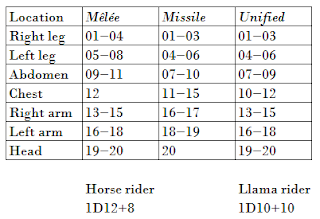
RuneQuest 2 had a simple universal hit locations table, which was applied to a humanoid target irrespective of whether the attack was via a mêlée weapon, a missile, or a spell. The table is the one in the first column (Mêlée) in the illustration at the bottom of this blog post. There were a few modifiers to be taken into account if the attacker was on horseback or riding a high llama (one of the bizarre riding animals used by the Praxian animal nomads).

RuneQuest 3 kept the same table as RuneQuest 2 whilst restricting its use to mêlée combat and adding a second, slightly different, table for the results of missile combat — which made perfect sense. Please refer to the tables in the first two columns (Mêlée and Missile) in the illustration at the bottom of this blog post.

The Basic Role-Playing System “Big Gold Book” (BGB) used the same exact tables as RuneQuest 3.

RuneQuest 6 has introduced a slightly different table, which is supposed to replace both the Mêlée and the Missile tables from RQ3 and the BGB; please refer to the table in the third column (Unified) in the illustration at the bottom of this blog post.

Personally, and in contrast to the latest outcries about Chaosium splitting the RQ fanbase again with yet another version of the RQ rules, I find the various incarnations of the rules sufficiently similar that I can use them interchangeably; e.g., I have recently run my RQ6 Swenstown scenario twice, and I've used the RQ2 hit locations both times... only realising whilst re-reading the various rules sets to write this blog post that they were actually different!

Anyway, my suggestion is to use a mix of the RQ2/3 and RQ6 hit location tables as follows: the first column for mêlée combat, the second column for missile combat, and the third column in all other cases (e.g., falls, spells) or if you only want to use a single hit location table.


Also please remember that a combatant in a superior position adds +1 to the D20 roll for hit locations.

RuneQuest Classic - If You've Missed The Kickstarter...

$
0
0
So, if you've missed out on the one and only Kickstarter crowdfunding project that you shouldn't have overlooked if you were a true-blue fan of Old School role-playing games, here is a chance to still be able to pre-order the 'new' version of RuneQuest 2, elegantly called RuneQuest Classic: link.

This is not a mere reprint. It comes with additional content such as a lot of Q&A from the 'RuneQuestions' column in Wyrms Footnotes (Chaosium's in-house organ), new appendices ('The Birth of the Minotaur' by Greg Stafford, precisions about Divine Intervention and Divination, 'What It Takes To Convince The Examiners' also by Greg, precisions about ghosts and spirit combat, and of course a full description of Rurik Runespear, Runemasters-style), a GM screen, and player handouts.

As a whole, the additional content amounts to 7 pages of small type in the appendices, and to various instances of boxed text interspersed throughout the main text of the rulebook.

The Man Is Back!

$
0
0
Steve Perrin, the man behind most of the original mechanisms used for the RuneQuest rules, is back! Here is the press release from Chaosium:

Steve Perrin joins design team for new Chaosium edition of RuneQuest

In the spirit of bringing the band back together, Chaosium is delighted to announce that Steve Perrin is joining the design team for Chaosium’s new edition of RuneQuest. "We knew that Steve Perrin’s place at the table, as both the creator and lead author of the original groundbreaking ‘78 and ‘79 editions of game, was a natural fit that harkens back to the genius and originality of RuneQuest", said Rick Meints, President of Chaosium.

In late 2015 Moon Design Publications and Chaosium successfully Kickstarted the RuneQuest Classic Edition campaign, a triumphant reissue of the iconic 2nd Edition of the RuneQuest rules and the supplements produced for it: Cults of Prax, Pavis, Big Rubble, Griffin Mountain, TrollPak and many others.

“We want to usher in the newest exploration of Glorantha with a tribute to the masterpiece opus of work that has come before. Part of Steve's role is to help insure that this edition contains the best possible game mechanics while maintaining backwards compatibility with RuneQuest 2", said Jeff Richard, creative director at Chaosium.

The new version of RuneQuest maintains backwards compatibility with earlier editions, while also containing a number of unique innovations that resonate with Glorantha, Greg Stafford's mythical campaign setting where RuneQuest started and to which it returns. This new edition incorporates Runes directly into both your character and the magic system you use, including their passions and motivations.

"The rules reinforce immersion in the setting even more than the original RuneQuest rules did, and ideas experimentally brought forth in Griffin Mountain reach their fruition", said Richard.

Seizing this unique chance to get this right, Chaosium has brought in a team of notable game designers to support Chaosium’s rebirth of RuneQuest, including Sandy Petersen (Call of Cthulhu), Ken Rolston (Paranoia, Elder Scrolls, RQ3), Chris Klug (James Bond 007 RPG, DragonQuest) and Jason Durall (BRP, Conan).

A special pre-release version of the new rules will be revealed at Gen Con later this year, along with introductory scenario sessions. A wealth of all-new campaign material and supplements for the new edition will follow.

The New RuneQuest - First Snippets of Information

$
0
0
The Chaosium have released the first real snippets of actual information about the new incarnation of their flagship role-playing game (no, it's not the Call of Cthulhu). You can click here to get to the relevant post. I am sceptical about the“launching at Gen Con this year” bit of the article. The Gen Con is in August; a launch in August 2016 is tantamount to saying that the game is almost finished and in its very final playtesting phase, yet Steve Perrin has just recently jumped on board, and it seems any playtesting at the moment is restricted to the Chaosium inner circle, so....?

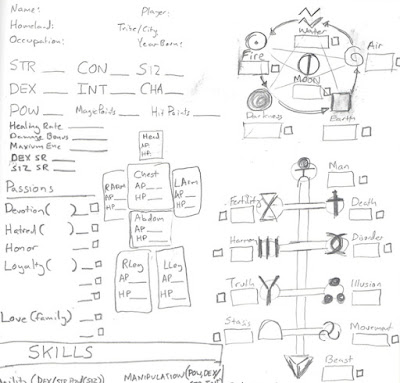
Anyway, what has caught my interest is not the aggressive time-line, it is the picture of the hand-drawn player character sheet:


I like the fact that we're ending up with way more runes on the player character sheet than in HeroQuest Glorantha or in the short-lived RuneQuest Adventures in Glorantha.
I also like the fact that this feature directly reverts Gloranthan cosmology as presented p146-149 of the Guide to Glorantha (but what about the other Form runes?).


The New RuneQuest - Snippets of Information (cont'd)

$
0
0
The second instalment on Chaosium's blog about the birth of the 'new'RuneQuest is here.

TL;DR
  • A short overview of what makes RuneQuestRuneQuest.
  • A short overview of why RQ2 is superior to RQ3 and hence used as the basis for the 'new' RQ.
  • Globally, this last blog entry sort of answers the sceptical remark I made yesterday about the draft being available for Gen Con: the 'new' RQ is more like a RQ 2.5, hence its short-term availability.

The New RuneQuest - A Candid Retelling of 2015

$
0
0
In his third instalment about the 'new'RuneQuest, Jeff Richard quite candidly retells the whole Chaosium/The Design Mechanism imbroglio from last summer. Even though I was quite shocked at the news of the demise of RuneQuest Adventures in Glorantha at the time, I have come to understand the reasons behind this business decision, which, given the success of the RuneQuest Classic Edition kickstarter crowdfunding campaign, was certainly a sound one.


News From The Design Mechanism

$
0
0
I always hesitate before publishing this kind of blog entry.... I reckon most people reading my blog also scour the various D100 forums and G+ communities. But, well, who knows, maybe there are people who only read my blog, so here are the latest news from The Design Mechanism for your enjoyment.

1) RuneQuest 6 will be re-named Mythras. The book will be re-printed with the same content and the same cover illustration; only the name will change.

2) The next supplement out is a much-revamped incarnation of the former BRP monograph titled Classic Fantasy. There is a preview here, and the cover simply rocks:

This is so Old School! I love it.

Apparently it will be much more than a mere Old School supplement for RuneQuest 6; with Mythras firmly rooted in the ancient world and the bronze age, Classic Fantasy will be the basis for faux mediaeval adventuring using the RQ6/Mythras rules.

3) Rumours are re-surfacing again of Chronicles of Future Earth by Sarah Newton being re-written for the RQ6/Mythras rules set. Stay tuned...

The New RuneQuest - How It Will Use Runes

$
0
0
The fourth instalment in Jeff Richard's design notes about the new RuneQuest is available on the Chaosium blog. This latest blog entry is mostly devoted to Gloranthan Runes and to how they will be used in the new RuneQuest.

In my opinion, there are two salient points: (1) Rune skills, and (2) Rune points.

Runes, much like in the short-lived RuneQuest Adventures in Glorantha by The Design Mechanism, will be directly expressed in gaming terms by straight percentile skills, and quite high-level ones too.

Apparently the player will have to choose three elemental runes and receive interesting starting scores in them; the example mentioned in the blog entry is Air 60%, Moon 40%, and Fire 20%. RuneQuest Adventures in Glorantha usually envisioned a single elemental rune at start.

The other runes (see my earlier post) function in opposing pairs; their total being always 100%, the worst score in one of them is necessarily going to be 50%. Not bad for a starting skill.

Apparently Rune Magic has been singled out as one of the weak areas of RQ2, what with sacrificing your POW for single use spells. Apparently a new mechanism will be implemented: Rune Points. RPs will fuel Rune Magic spells just like MPs fuel Battle Magic spells. They will still be ‘bought’ by sacrificing POW; however, it seems they will be easier to recover.

The Sea Cave

$
0
0
I have received the PDF of the RuneQuest Old School Source Pack from the RuneQuest Classic edition kickstarter. It is a collection of all the very early RQ supplements, incl. The Sea Cave, which is an original unfinished and unpublished adventure by Greg Stafford. The Sea Cave is rather in the style of the quite lethal old school adventures of the time. Here are a few salient points I enjoyed whilst reading it [WARNING– MAJOR SPOILERS]:

“When adventurers are slaughtered or run screaming, the Monsters get experience rolls too.” I guess this is to make the adventure tougher should the PCs return to it. This sentence has a nice Monsters! Monsters! flavour to it which, being a huge T&T fan, I have really enjoyed reading.

At the beginning of the scenario, there is a section dedicated to tides in Glorantha, and to how the exact day the characters start the adventure may influence its outcome.

The text makes a difference between Denizens (remain in the same area) and Inhabitants (move from one area to the other) of the Sea Cave. The referee must decide where the latter will start off at the beginning of the scenario. This is decision is a mix of referee agency and of a random die roll influenced by the tide.

Rather than wandering monsters, the referee has a table to roll up random items in the various locations. The items go from the mundane (a shark tooth that was part of a necklace) to the hazardous (a magical skull that attacks the PCs) or the magical (an aluminium whistle). They are globally Gloranthan-themed, and contribute to making the adventure more than an average dungeon crawl.

The monsters themselves depart from the tedious monster-in-a-room-guarding-a-treasure design philosophy (or lack thereof) typical of the 1970s/1980s. The Trolls have family ties, know how to read and write, and do not get along well with the Sea Wyrm. The Mermaid also opposes the Wyrm. It is an interesting little monstrous ecosystem.

There is also a faux boss, which is a clever little twist. The PCs will think they have killed the boss,  collect the reward... but then the villagers who have hired them will still be plagued by mystery attacks at sea... possibly prompting a second foray into the Sea Cave, and making this adventure re-usable :)

Unfortunately, since this was an unfinished and unpublished adventure in the first place, the maps are quite terrible. Furthermore, a very short appendix at the end of the adventure explains that Greg had originally intended to add a temple to Cacodemon to the east of the cave complex; there are stats for the priest. Speaking of stats, they are handwritten on RQ monster/NPC sheets and are particularly difficult to decipher. I wish Chaosium had made the extra effort to print them rather than merely photocopying them.

All in all, it is a very decent adventure, possibly playable in a single session (depending on how long the PCs stay in the fishing village to investigate/hire a boat before heading to the cave).

FG Con: Revolution D100 On-Line Demo Game

$
0
0
As implied by its name, FG Con is an on-line convention devoted to the popular on-line tabletop RPG platform Fantasy Grounds. The on-line convention is taking place from 8 to 10 April 2016.

An official adaptation of the Fantasy Grounds engine to Revolution D100 has been available for some time now for a select group of happy playtesters. Yours truly can testify that it is really a top-notch adaptation that almost gives you the same experience as playing in the same room as your friends.

Paolo Guccione, the author of Revolution D100, will be demoing it on Saturday 9 April from 9pm to 1am CET. You may register here.

Paolo may run further on-line demos, depending on how many people subscribe. Paolo is an 'Ultimate GM', meaning players needn't have a Fantasy Ground licence. You can play in his games for free – just download the software and play. You will also receive a link to the latest version of the Revolution D100 SRD, and a library module with the most important tables and charts.

The Hanging Garden, Issue No.5

$
0
0
Howdy dear readers. The fifth issue of my free e-zine, The Hanging Garden, is available for your perusal and enjoyment from the usual page.

Issue No.5 is a special "Old West"-themed issue. It contains several interviews, articles, and three full-length scenarios (two for Basic Roleplaying, and one for GURPS).

Feedback and comments are welcome, as usual. Cheers!

The Hanging Garden, Issue No.5 – Updated!

$
0
0
Issue No.5 of The Hanging Garden has been updated with a full-length article about Boot Hill by Travis Casey. Enjoy!

Chimeriades & RuneQuest 4

$
0
0

Long-time readers of this blog know that there are three conventions I love and have almost never missed: the one in Bacharach in Rhineland-Palatinate, THE KRAKEN in Brandenburg, and Chimériades in the Luberon.

Well, Chimériades V starts tomorrow, and I am oh! so excited to go. The highlight for me will be Chaosium's own Jeff Richard making the first public appearance of the new RuneQuest rules (which Jeff calls ‘RuneQuest 4’ — not sure if that will be the official name though). I will be playing in a game refereed by Jeff on Thursday night — watch this space if you're interested by my first impressions!

Back From Chimériades V

$
0
0
Back from the first con in ‘con season’!  This year’s Chimériades took place in the same wonderful village in the Luberon as the two previous incarnations.

As usual, here is my feedback for the poor souls who had other priorities in life than travelling to a wonderful château in a seraphic location to enjoy role-playing under the Provençal sun. [Important notice: since I’ve had an appalling H1 2016 at my day job, I am in fuсkwit mode at the moment, so: no GMing at my side at the Chimériades (nor will I GM at the Eternal Con in Bacharach), and I must also disclose that I have stolen from various friends’ con summaries to complete mine.]

Blue sky, ochre castle *


THURSDAY 5 MAY, evening

Chimériades aren’t particularly known for their being a ‘dry’ convention, but the organisers have overachieved this year… after the inaugural ceremony, several tables of fresh mojitos were expecting us in the courtyard of the castle. Also by the end of the con, we hadn’t run out of beer kegs (contrary to what happened in 2014…)!

Beer and mojito *

Mojito Army †


Another big subsistence-related surprise: this year the food was prepared by a professional caterer! We had fantastic paella cooked in huge frying pans just in front of the château. So most of us started the three-day playathon sipping a fresh mojito in the mouthwatering smell of frying capsicums. I’ve definitely experienced worse at a con.

Keep it flowing †


THURSDAY 5 MAY, late at night

I had obviously signed up for Jeff Richard’s very first worldwide open playtest of the new RuneQuest rules! First significant surprise: you are encouraged to play a party of characters from a similar background, and the [quite long] character generation is not dissimilar from the Sartar clan generator in HeroQuest, except that each character is similarly created via a long questionnaire, and not the clan or the character party itself. As a result, and since there were five of us, this took almost two hours, at which point we decided to play the actual scenario the following day in the early morning. Second surprise; the rules are really, really close to RQ2, even more so than what Jeff had hinted at on G+. To me, it looks like Chaosium’s two guiding principles in this endeavour have mainly been “remove unnecessary rules” and “if it ain’t broke, don’t fix it”; I am happy with 99.9% of the results… I only miss the Defence skill, but since apparently I am the only such person on Earth, it shouldn’t be an issue for most of the fans.

A thick manuscript! *


FRIDAY 6 MAY, morning

OK, so were all from the same ‘Old Tarshite’ village on the slopes of Kero Fin, and Jeff demonstrated that you could play an intense hero quest even with beginning characters. We all had the opportunity for mucho roleplaying and we got to try out all the new skill combinations, augments, etc. All I will say here (since RQ4 definitely warrants its own dedicated blog post) is that the new system works flawlessly, that there aren’t any maths involved (augments are flat ±20%, not percentages of percentages), and that rune magic ROCKS. These first impressions still have to be confirmed, of course, since I’ve only played a mere one-shot, but as much as I enjoyed the short-lived RuneQuest Adventures in Glorantha supplement for RQ6, I have had the impression at Chimériades that we had found –at last!– the holy grail of Gloranthan old school role-playing!

My first RQ4 character sheet! *


FRIDAY 6 MAY, 10:30, first panel: Gloranthan Round Table

The first panel of many that were available (and of which I only attended two) was the Gloranthan Seminar with Jeff Richard and Ken Rolston.

Jeff and Ken Talk *


As usual, the first questions were about upcoming products— so:

The Coming Storm is at the printer. The first book is expected in time for Gen Con. The second book is at layout, and is scheduled for the end of the year.

13th Age in Glorantha (13G) is at its final review stage. Currently at 400+ pages. Scheduled for the end of the year. As Jeff goes through the edits of 13G, he adds relevant stuff here and there to the 1627 sourcebook to make sure everything mentioned in 13G gets properly covered in the sourcebook, which BTW is a myth book; the model for the sourcebook is the myths articles in Wyrms Footnotes. The sourcebook will be useful for all Gloranthan-based role-playing games and not only for 13G, since all Gloranthan RPGs now heavily revolve around hero questing – and hence myths.

New RuneQuest core rules. Public playtesting in the next few weeks. Missing sections: hero quests, new sorcery [note that there won’t be any Malkioni in the core rules, only Grey Sages will have a few sorcery spells]. The full manuscript is scheduled for Gen Con. The new rules are designed to be backwards compatible with all the reprinted RQ2 products, which are going to be back in publication and printing.

Six Ages (successor to King of Dragon Pass): finished writing, missing the art. Looking at end of 2016/beginning of 2017. Set in Glorantha, but not in Dragon Pass [yours truly suspects Esrolia].

Gods War is being kickstarted this summer, by Petersen Games and Moon Design.

Wyrms Footnotes issue 16 will gather RQ material that won’t have made it in the published book.

Once the rules books are out, supplements will have to be rolled out… An “Esrolia Pack” is in the works (the published Nochet map was the first step).

The new Dragon Pass boardgame by Chris Klug is currently being playtested. It is designed to be played in 90 minutes. The aim is to kickstart it at the end of 2016.

Reiner Knizia card game: each player is a Praxian khan raiding the other clans. Fun, fast-paced filler game (20- to 30-minute play time).

Trollball proof-of-concept boardgame using miniatures from Petersen Games. A few pictures were posted on G+. No schedule at the moment.

HeroQuest: Glorantha in French, directly published by Moon Design— no intermediaries!

Jeff and Ken also mentioned that Glorantha should not be seen as a “scholarly” world any longer: GMs now have the Guide at their disposal, and beginning players should have enough understanding of their starting locale thanks to the character generation process in RQ4.

FRIDAY 6 MAY, afternoon

Rightly expecting not to be in great shape for Chimériades, I hadn’t booked anything for the Friday afternoon slot. I have thus been able to leisurely walk through the castle and its gardens to see the various RPG tables, and more.

Basking in the sun... *

...and playing RPGs *


Stéphane Gallay was playtesting Gingerbread (working title), his new RPG in which the players are students in a super-hero academy. Readers of a well-known French graphic novel will feel at home. I didn’t play, just watched, but the system seemed quite reminiscent of Hero Wars.

Stéphane and his playtesters *
I’ve also enjoyed listening to my friends playing Grégory Privat’sBimbo RPG. I love how the game “forces” the players to be creative both in how they describe their character’s actions and in how they have to talk in-character.

Bimbos in the sun †


I have drooled at length in front of a copy of Cthulhu Wars painstakingly painted by Grégory Privat that you could win thanks to the lottery (alas, I didn’t).

Lottery prize *


There were nice Gloranthan decorations everywhere in the castle, this year being the 50th anniversary of Glorantha (but more on this later), including some unpublished illustrations!


Some friends of mine were playtesting the 21st century version of an old favourite of ours…

Er, I think the Red Emperor is dead! †

Also the usual publishers’ and resellers’ booths, etc. Other friends playing, and various games being demo'ed.


FRIDAY 6 MAY, night

Another piece of epic Gloranthan gaming! Early in the year, Éric Vanel had adapted the BattleLore rules to Glorantha for an in-campaign battle that we played during the course of his HQ campaign. Since we all loved how the game had played out, he decided to use those same rules to render the battle of Dangerford (from the Coming Storm) as a standalone wargame.

I acted as the co-referee. We had 5 players on the Lunar side, 4 representing the Sartarite rebels. The game played really well, the only problem was that the players who had received the rear-guard counters didn’t get to play much. Also, the Sartarite units exaggeratedly benefited from a scaling error on the map that made the Creek much wider than it really is, hence decreasing the efficiency of the Lunar units that use ranged weapons and/or magic. Hopefully a version 2 (for THE KRAKEN?) will fix these small shortcomings because except for these the game was fantastic.

Map and counters *

Gaming Aid *

And... Action! †


SATURDAY 7 MAY, 10:30, second panel: Ken Rolston: What I’ve Left Undone

This had been advertised more as a workshop than a panel, so I had assumed we would be creating stuff with Ken Rolston. We ended up mostly listening to Ken talk about CRPGs –which I hate– but him being the Rune Czar it was still very interesting.

Ken globally talked about failed games, how he pitched them to bigwigs, what they could have been… The one that caught my attention most was ‘Exile’, a mix of Civilization and Oblivion, and ‘Markland’, pitched as Sartarites settle the New World, or Elves and Dwarves settle a post-Hobbit Desolation of Smaug. I also remember this particular sentence: “Managing artistic people is like herding cats”.

Oh, and Ken did mention a single failed tabletop RPG: Seals of Satan (published in White Wolf Magazine issue No.42) with, er, cute seal-like demons firing death rays from their eyes!

The Rune Czar Talketh *


SATURDAY 7 MAY, afternoon

The usual perk at these cons is that you get to play with the very authors of the games, and so I managed to secure a place at Camille Guirou’sThe Cardinal's Blades table to enjoy her adventure le Serpentaire (the word means both ‘Secretary Bird’ and ‘Ophiuchus’ in French, and both meanings played an important role in the scenario…). It was really one of the most enjoyable adventures I’ve ever played, with a breathtaking in medias res opening, great locations (Provence in the 17th century), and possibly the best NPC I’ve ever been confronted to. Loved it!

*


While I was enjoying Camille’s game, some other lucky friends were playing Scions of Ralzakark with Ken Rolston. This was a scenario Ken had already GM’d at THE KRAKEN… Can you believe I missed it twice?!


SATURDAY 7 MAY, late afternoon and night

Alas, alas, even the best cons get to an end, and we had a moving closing ceremony, during which Philippe confirmed there would be another con in 2018.

After the traditional barbecue dinner (yes there were vegetarian patties) the organisers had a big surprise for us Gloranthan fans: a score tartes du Luberon with Gloranthan runes on them! This is part of what makes the Chimériades so special.


Beauteous!! †


Thank you, thank you, thank you again to Camille Guirou, to Philippe Auribeau, to Rémy Croxatto and to all the other organisers, and see you in 2018!

Un jour, toujours


The ugly pictures (unmarked or marked *) are by tours truly.
The beautiful pictures (marked †) are by Stéphane Gallay, under a creative commons licence.

Back from Bacharach

$
0
0
I would've never believed that I'd write this, but two cons in a row, well— that's pretty exhausting! After having spent a few days in the Luberon, back to work for a few days, and then off to the Eternal Con (7th edition!) in Bacharach on the left bank of the Rhine.

A short lunch break whilst travelling to Bacharach


Now, the Eternal Con has always been a "family-friendly" con, but I had the impression, this year, that it was really, really more diverse than usual in terms of gender and age. We had lots of families, lots of kids (more than 25!). Lots of new babies this year too! And many events. As a result, I will only concentrate on the ones I managed to attend.

the Rhine


FRIDAY 13 MAY, 19:00, Grand Opening Ceremony

This was held, as usual, on Friday night. Just like last year, Franziska and Charlotte were our hosts and entertained us with their witty humour and a faux Who Wants to Be a Millionaire? quiz show that featured RPG-related questions. It was really all good-hearted and very funny, much like a reunion of old friends. I think at one time the organisers asked "who is here for the first time" and only two people raised their hand!


Opening Ceremony

FRIDAY 13 MAY, late evening, Friendly Gloranthan chat with Jeff Richard

Jeff gave us pretty much the same information as at Chimériades, so please refer to my Chimériades report here.
I'll concentrate on the extra details that we didn't get at Chimériades in this blog post. Jeff said, for instance, that the mammoth Gods War boardgame will be cheaper than Cthulhu Wars even though the miniatures are more awesome.
With regard to RuneQuest Classic: the books will be carried by game shops (yay!).
RuneQuest 4 (lots of extra news):
  • We all had a small discussion about spirits and spirit combat. Apparently spirits in RQ4 are going to be based on Stormbringer demons in terms of potential for customisation.
  • Rune magic is going to be available before rune level— actually right at the time of character generation. Rune level characters will simply get back their rune points much faster.
  • Sorcery is going to be based on four core skills, hence a high learning curve.
  • Also, the whole price system has been re-written.
Jeff and Ian


SATURDAY 14 MAY, 10:00, New Conan RPG Seminar with Jason Durall

Modiphius got the Conan licence two years ago. At the time, Jason Durall was working (with Modiphius) on the Achtung! Cthulhu: Assault on the Mountains of Madness campaign pack. Modiphius asked Jason to work on the new Conan RPG as the line developer, and Jason, who has been a huge Conan fan since he was 9 years old, enthusiastically accepted.

There have been lots of Conan RPGs in the past... So why a new one? Here are the design pillars of the new game, which Jason thinks make it stand out of the RPG crowd:

1- Inspiration.
a- The source material is pure Robert E. Howard, no pastiche, no movies; e.g., all the characters' names, locations, etc. were double-checked by REH scholars. Hence the exact name of the game: Robert E Howard's Conan.
b- It has been decided that the stories set in the same world as Conan but without Conan are canon source material. Even other REH works like the Kull or the Lovecraftian stories are!
c- Time-frame of the core RPG: about the time Conan 'enters the stage' (he's about 17 years old). The setting of the core book is centred on Cimmeria and the surrounding countries (Aquilonia, Hyperborea), and hence focuses on clan warfare, border skirmishes...
Later sourcebooks will cover later eras and more southerly areas (e.g., Zamora), thereby introducing different flavours of setting: the Zamora book is thief-oriented. A later book will focus on being a sea pirate. I think that's pretty clever.

2- The system will be strongly pulp-oriented. The idea is that the characters start heroic; rather than become more powerful with experience, they get more diverse powers.

3- The setting will feature exotic places, strange technology, mysterious ruins... all the ingredients of the sword and sorcery subgenre, of which REH is regarded as the father.

Jason


In parallel to the source books, there will be an adventures book, a magics book, a cults book. Jason said they were looking at something like 18 books, already funded by the kickstarter. Additional standalone adventure will be available as PDFs.

The System is called 'the 2d20 system'. You basically roll 2d20 and use the best one... sort of like the advantages system of other games, except it is always on! Skills give you extra dice, and you may trade automatic successes for "doom points" to the GM.


beauteous cover!

SATURDAY 14 MAY, 14:00, Conan game with Jason

We started as a ragtag mix of adventurers and Aquilonian soldiers in the Bossonian Marches, between the Black River and the Thunder River. I was playing Maeve, the Talented Archer (a kind of female Conan, really).

We only used d20s and d6s to play. The rules are heavily combat-oriented, with lots of "visual" manoeuvres that directly translate into dice-related effects (re-roll, add 1 die, etc.); it's fun and easy to learn, way simpler than RuneQuest 6 or Revolution D100. Not much else to add on the 2d20 system part... It really works well for combat! (and I'm the guy who's usually bored during combats), I would say slightly less so for non-combat skills. I only have two pieces of criticism with regard to the game mechanics: (a) We dispatched our opponents too easily, even the big fat sorcerer at the end of the adventure, and (b) You usually lose no vigour/health points during combat until a given threshold where all of a sudden you lose a lot of them!
Anyway, the system is still being refined. Note: Apparently the 2d20 system hasn't been created ex nihilo for the Conan RPG but it is a reworking of an early, already-existing system (from the free Drifting Through Space RPG – also by Modiphius).

And we had lots of "I hit it with my axe" utterances — proof of a good S&S game :-)
Conan game

SATURDAY 14 MAY, 14:00, German RuneQuest 6 seminar

There was a seminar presenting the German-language version of RuneQuest 6. I missed it.


SATURDAY 14 MAY, afternoon

While I was playing Conan, some people out there were having fun in a  Glorathan freeform!

Yanafal Tarnils cultist

Babeester Gor cultist

Classic Fantasy with the RQ6 rules

After the freeform, some of my friends played RuneQuest 6 in German while I went for...

SATURDAY 14 MAY, 19:00, HeroQuest game set in Japan

This was run by Robin Mitra himself, who translated HeroQuest in German, and it was in German! The game started with a lengthy clan generation questionnaire à la Sartar: Kingdom of Heroes. It was very funny and helped me get into the game (not that I don't know Sengoku Japan — it's just that I'm not used to playing in German).
The clan generation questionnaire and the adventure itself were full of cultural detail, and devoid of the usual anachronisms one finds in faux Japanese RPGs. Kudos to Robin. When one thinks that this was not a fully-fledged Japanese HQ setting, but a mere adventure from a book collecting 15 different adventures for HeroQuest... I wish it were translated to English!

Sengoku Japan HeroQuest Game

SUNDAY 15 MAY, 10:00, Trollball

This was the traditional Trollball game in the court of the castle. I missed it because I was playing downstairs in the castle.


SUNDAY 15 MAY, 10:00, Revolution D100 game

Simon Phipp, he of the acclaimed Merrie England RPG, demonstrated the brand new Revolution D100 rules. We had a very refreshing adventure set in 12th century England with much intrigue and little combat.

Morris Dancers Adventuring!


SUNDAY 15 MAY, afternoon, 1714: The Case of the Catalans boardgame

I had already noticed this game on the Saturday, but unfortunately couldn't play it. I managed to play on Sunday though, even if it was in the three-player version.

My, what a fantastic card-driven wargame~boardgame! There are so many cool ideas in it:

1) All the players are allied against the French (whose actions are driven by some of the cards) yet you're obviously vying against your "allies" to win — without being allowed to attack them. Intrigue, manoeuvring, and especially resources (whose significance I figured out way too late into the game) are of paramount importance if you want to win.

2) There are two possible outcomes: the French "win" (by taking Barcelona) or they "lose" (by losing too many troops); depending on the outcome, the victory conditions are different. So depending on what kind of victory points you amassed you are going to try and favour one outcome rather than the other. And you will never know, until the very end, how your VPs are going to be computed!

3) Each country has a 'Will to Fight' gauge. The more goals you reach, the more your Will to Fight decreases... and under a given threshold you're not allowed to recruit and to move armies any longer!

Anyway, this was probably the game I preferred during the whole con. I can't believe I'd never heard of it.


SUNDAY 15 MAY, 19:00, Chaosium seminar with Jeff (as creative director)

Since there had already been a Gloranthan seminar, this one concentrated on Chaosium's other products, mostly Call of Cthulhu 7th edition.

Jeff mentioned that Pulp Cthulhu was out next, and that there were lots of products in the pipe, in particular Sandy Petersen'sCall of Cthulhu adventures (2 volumes).
More generally on the product themselves, Jeff explained that the level of art would be top notch from now on, at least the same level of art as in the French Sans Détour books.
What to expect in the future?
  • Lots of licences: Call of Cthulhu video game, Pathfinder supplements (!)
  • More co-operation with European companies (Sans Détour, Pegasus Spiele)
Mythic Iceland 2nd edition this year.

No non-Gloranthan HeroQuest products in the pipe.

Fiction line re-launched this year, done with more care, because it's important.

SUNDAY 15 MAY, 21:00, Closing ceremony

So sad.


SUNDAY 15 MAY, 23:00

Played the Operation Market Garden wargame that I had already played at THE KRAKEN.

Note: some pictures by Heini.

Revolution D100 SRD

$
0
0
Revolution D100's System Reference Document (SRD) is on-line and it is free! You can find it here.

Since this new, crowdfunded D100-based system by Alephtar Games hasn't been officially released yet, the SRD is bound to undergo further modifications, in particular based on playtesters' feedback.

Enjoy.

RuneQuest 4 - First Impressions

$
0
0
So my friends and I were lucky enough to take part in the first worldwide open playtest of the new RuneQuest rules by Jeff Richard at Chimériades V.

The following is a modified and summarised translation of Grégory Molle'soriginal French-language post about the new RuneQuest rules, with a few additional impressions thrown in.


At the last Chimériades convention, Jeff Richard refereed two games with the new RuneQuest rules. I played in the second game; I got to create a character, play a short two-hour game with four fellow players, and peruse the printout of the latest draft of the game.

RuneQuest 4 or 2.5?


By the way, what version of the game are we talking about, exactly? Jeff talks about RuneQuest 4, because he considers the game as a successor to the 3rd edition, the one that was created by Chaosium but published by Avalon Hill in 1984. This is tantamount to “erasing” the Mongoose editions from the 2000s and the one by The Design Mechanism a few years ago – not to mention the unpublished RuneQuest: Adventures in Glorantha by Oliver Jovanovic, Michael McGloin and Carl Fink that should have been published as a successor to RuneQuest 3.

This having been said, this new edition of RuneQuest is also sometimes referred to as RuneQuest 2.5. Why? Because it is sort of a step back from RQ3 that the new 2016 Chaosium consider crippled by now-obsolete rules (fatigue points) or clumsy ones (one-use rune spells, sorcery). The starting point of the new RuneQuest game is hence its “classic” version, i.e., the 1979 edition known as RuneQuest 2. The fans’ commitment to RQ2 has been showcased by the hugely successful RuneQuest Classic Kickstarter crowdfunding campaign in 2015 that raised more than $200,000.

However, since RuneQuest is back in a Glorantha-specific version, and not as a generic fantasy role-playing system, we might as well call it RuneQuest Glorantha. The game credits the following people as its authors: Steve Perrin, Greg Stafford, Sandy Petersen, Jeff Richard, Ken Rolston, and Chris Klug.

Character Generation: Pendragon and HeroQuest to the Rescue


Character generation assumes the choice of a homeland and of an occupation that will affect the values of some skills. The skill categories have not changed since the 1980s: magic, agility, communication, knowledge, perception, manipulation, stealth. The homelands available in the game are Sartar, Esrolia, the Grazelands, Lunar Tarsh, Old Tarsh, and five Praxian tribes: Bison, High Llama, Impala, Pol-Joni, Sable Riders.

Characters are defined by the seven traditional characteristics (Strength, Constitution, Size, Dexterity, Intelligence, Charisma, and Power), by their magic points, hit points (with hit locations), strike rank modifiers (Size, Dexterity), damage bonus, and maximum encumbrance (beyond which you undergo negative modifiers). This will all look very familiar to RQ grognards. The Defence skill from RuneQuest 2 has disappeared, and a new ability, healing rate, has appeared.

Where it starts getting groovy is in the top right corner of the character sheet, where you can spot two runic diagrams! Oh yes, RuneQuest has at last deserved its very name.

The first diagram is about the six Elemental Runes – Water, Air, Earth, Darkness, Fire/Sky and… Moon! You choose a main rune whose score is set to 60%, then three others that respectively obtain 40%, 20%, and 10%. These are the basic scores: further modifiers may come into play, so that Branduan, my Sartarite character, ended up with 60% in the Moon Rune (OK, he was a Eurmali skald whose paternal grandmother already was a trickster, see below), 20% in Darkness, 10% in Water but 70% in Air (after adding two bonuses, +10% and +20%, to an initial score of 40%).

The second runic diagram is reminiscent of the Pendragon personality traits table since it opposes five pairs of Power Runes – Fertility / Death, Harmony / Disorder, Truth / Illusion, Stasis / Movement, and Man / Beast – whose values are linked: the sum for a given pair must be equal to 100%. I don’t remember the actual procedure but I know that, with the choices I made, Branduan ended up with two pairs of Power Runes having scores different from 50% / 50%: Illusion (95%) / Truth (5%) and Movement (75%) / Stasis (25%).

Whether Elemental or Power, the Runes can be used to improve, via a set bonus, the score of a given skill, sort of like in HeroQuest. A successful roll under a relevant Rune, e.g., the Illusion Rune for a thief who is trying not to be noticed by their victim, yields a 20% bonus to their Sneak skill score. However, should the roll under the Illusion Rune fail, the inability of the character to attune to that particular Rune at that moment in time yields a 20% negative modifier to the skill. I’m not sure at the moment if the modifier is always ±20% but it definitely seemed to be the default value.

Moreover, just like in Pendragon, the Power Runes can be used to influence the player’s actions; for instance, acting in a way that is in contradiction with a given Power Rune in which the PC has a high score might decrease said score – or prevent the PC from acting the way they are.

That’s more or less all with regard to Runes. We have used them a lot during our two-hour game, meaning they are not there as a fancy addition, they are really part of the core mechanics of the new RuneQuest game. One must really weigh all the options at character generation, in particular in order to avoid redundancy among the player characters. While I was perusing the printout of the draft rules, I’ve also noticed that the description of the Runes assumed a host of symbolic associations: personality traits, senses (sight, etc.), skill categories, arms, colours, metals, animals and… body organs [editor’s note: this is all very reminiscent ofwǔxíngin Chinese cosmology]. For instance, Moon is associated with the pineal gland, which the Grey Sage Wikipedius tells us plays a central role in regulating the body’s biological rhythm (waking/sleep, seasons), which is really close to what we know about Lunar Magic and its cycles. This gives plenty of food for thought about using Runes in actual gaming sessions.

Yet another Pendragon legacy: passions. You get them while defining the background of the character (see below) – but I reckon you may also acquire them as-you-go (during play).

Branduan hates:
  • the Telmori
  • the Orleving Clan
  • authority in general

He also:
  • is devoted to his cult
  • loves his family
  • is loyal towards:
    • his clan
    • his tribe
    • Argrath (very present in the new game’s background since it’s been moved to 1627+!)
    • Erik (another PC, whose bonded trickster he is)

I realise now, by re-reading the character sheet, that all passion scores start at 60%. It’s maybe slightly too uniform, there should be more variety or randomness. This having been said, these scores will change during play via the skill check mechanism.

Ancestry


The next phase is the determination of the PC’s background, and that’s where you’re in for a ride. The new RuneQuest asks you to answer a long series of biographical questions, up to your player character’s grandparents. The game is set in 1627 – much like 13th Age in Glorantha– you must hence go back till the Battle of Grizzly Peak in 1582 to know what happened to your grandparents – at least for a Sartarite PC, because the events tables vary depending on the character’s culture.

A succession of tables will enable you to travel through Gloranthan time – re-read Pendragon, it’s the same concept – down to the present time. Are your grandparents still alive? There aren’t many probabilities that they all are, and it’s actually interesting to know what happened to them, because that will have repercussions for your character. There’s a family tree of sorts that unfolds. Regarding my character, I’ve discovered that his paternal grandmother was still alive in 1627, but that was kind of expected since a trickster is supposed to avoid combat rather than risk their life and amass glory like a nice Sartarite.

At some point, the story focuses on the character’s parents: one can witness the whole history of Dragon Pass and of Prax between 1608 and 1626. Then the focus shifts to the PC themself, and one may discover what has befallen them between 1623 and 1626. Branduan, left for dead during a raid by the Orleving Clan, eventually sought and found refuge in Pavis, where his skills as a trickster led him to being spotted by Argrath and to adventuring at his side before returning to Sartar and to his clan.

All in all, this biographical phase provides characters that have a detailed past while establishing a few points of reference for players who are not familiar with the world of Glorantha (it has actually reminded me of the clan creation in Sartar: Kingdom of Heroes). It’s also a fantastic way to create bonds between the various PCs. In our case there were clearly those whose background had been strongly influenced by clanic or tribal conflicts, and those who had simply wandered throughout Dragon Pass and who had serendipitously met Argrath.

The most spectacular consequence was that the character background generation phase strongly informed the adventure that we played. Jeff might have had some hidden agenda, I’m not sure about that, or maybe he deviated from it; anyway, he simply started the game by asking us: “What do you want to do?”. The answer that we provided was directly linked to the characters’ background. I’m not going to tell you all the details, but it had something to do with a revenge and conquest plan against the Orleving Clan, against whom our own clan bore an ancient grudge. This led to an encounter with Leika, the tribal Queen of the Colymar, and then – on the basis of the PCs’ background – we eventually met Argrath himself, who was busy conquering some former Lunar lands in the north of Dragon Pass, so as to involve him in our petty squabbles whilst promising him our allegiance in the future and feeling that we couldn’t fully grasp his innuendos. All this in two hours of play. That was far, far away from the usual introductory scenarios of our teenage years where we’d fight three broo and a half to defend our village!

a portion of the background part of the character sheet


And Also…


We didn’t use it during this playtest, but when I had a look at the rules, I found that a PC could have a family heirloom that was a “special” thing. Among the suggestions, there was “a small sentient animal” or “an iron object” – which is pretty cool.

I’ve also noticed there was a fast-track chargen, for people who wanted to start playing right away. It is something that was already present in RuneQuest 3, if I remember correctly.

I thought I’d read that the Resistance Table had been removed, but actually no, it’s still there; it’s just been removed from the Spirit Combat section.

There’s also a whole chapter devoted to Sacred Time, which (yet again) strongly reminded me of Pendragon. The new RuneQuest has been devised so as to enable campaign game, with long campaigns that entail one or two adventures per Gloranthan year. During Sacred Time, the background of the PC, or of the whole party, or of their community (or actually a little bit of each of them) is affected by some events. Based on my perusal of the draft rules, I remember titles such as “events”, “heroquest”, “omens from last year” (there’s something similar in King of Dragon Pass, with questions such as Did you take into account the omens from yesteryear’s Sacred Time during last year?), “raids”, “invasions”, “harvest”, “family”, or even “character income”, based upon their profession.

There was also a chapter about heroquesting but it was still a mere collection of notes, and there was a mention of a book of heroquests. Note: the other group of players did a heroquest during their introductory adventure, so it’s definitely not something only available to ‘high-level’ parties.

Voilà, you have an idea of the new RQ rules. Now let’s be patient until we can get hold of them!


Jeff has also blogged about family background in the new RuneQuest on the Chaosium web-site.

RuneQuest Classic Edition Char Gen

$
0
0
RuneQuest 2 (henceforth referred to as RuneQuest Classic Edition) is my all-time favourite fantasy role-playing game. Its age, however, shows in some of its aspects, and in particular in how unorganised and convoluted character creation is compared to modern games: you have to go back and forth between several chapters to “get character creation right”, and some information useful at character generation is hidden within the sections about character improvement.

Also, we’ve been used to using “professions” and “cultural backgrounds” from later incarnations of the game and from its sister publications, and forgotten (at least it was my case) how deeply “Old School” the RQ2 char-gen was, with its focus on adventurers’ organisations and on repaying back debt by looting dungeons...

Anyway, I present you here for your enjoyment (and, hopefully, for actual use) a summarised RuneQuest Classic Edition Character Generation primer, perfected with the help of the jolly RQ2 G+ community.

STEP 1 – Characteristics

Roll the character’s seven characteristics according to their race (roll 3D6 for each characteristic for a human character; see Chapter VIII of RuneQuest Classic Edition for other races):
  • STR ⓘ
  • CON ⓘ
  • SIZ
  • INT
  • POW
  • DEX ⓘ
  • CHA

ⓘ: can be increased by training, see step 7 below.

STEP 2 – Abilities and other Derived Characteristics

STEP 2a – Abilities
Compute abilities according to section A of the Classic Handouts.
  • Attack (skill category bonus)
  • Parry (skill category bonus)
  • Defence
  • Hit Points (Total HPs + Hit Points per Location using the table in section A of the Classic Handouts)
  • Damage Bonus
  • Perception (skill category bonus)
  • Stealth (skill category bonus)
  • Manipulation (skill category bonus)
  • Knowledge (skill category bonus)

Note 1: the Oratory skill does not fall in any of the previous categories.
Note 2: Should any of the character’s characteristics be increased by training, please do not forget to re-calculate the character’s abilities.

STEP 2b – Other Derived Characteristics
  • Movement (always equal to 8 for humans; see Chapter VIII of RuneQuest Classic Edition for other races)
  • Maximum Encumbrance, average of STR and CON, but capped by the character’s STR
  • Strike Rank Modifier, per the table in section A of the Classic Handouts.

STEP 3 – Starting Money

Roll according to section A of the Classic Handouts.

SPECIAL– Creating a Shaman Character
Becoming a shaman is so time-consuming that the character cannot undergo any other training (i.e., skip Steps 4 to 7). Please refer to pages 44 to 46 of RuneQuest Classic Edition.

STEP 4 – Compute Combat Skills

STEP 4a – Starting Combat Skills
The basic chance of all weapon skills is 5%, except when indicated otherwise (see section A of the Classic Handouts).

STEP 4b – Get Credit
These skill increases may be bought using the character’s starting money. However, since this amount is usually very low (and thus insufficient), a character may obtain credit from the various guilds; the credit is equal to STR × 100L.

STEP 4c – Increase Combat Skills
See tables on p26, p30 and p31 of RuneQuest Classic Edition.

STEP 5 – Compute Non-Combat Skills

STEP 5a – Starting Non-Combat Skills
The basic chance of each skill is indicated in the various tables in section D of the Classic Handouts.
Note that alchemical skills are not expressed in percentages.

STEP 5b – Get Credit
A character may obtain credit from the Thieves Association; the credit is equal to DEX × 100L. This credit may only be used to purchase thieving skills. Other guilds/crafts do not offer credit, and require apprenticeship in order to receive credit for training during character generation (see Appendix H of Chapter X of RuneQuest Classic Edition for more details on this).

STEP 5c – Increase Non-Combat Skills
See section D of the Classic Handouts.
Contrary to combat skills, non-combat skills are only taught by some guilds, which may have special requirements:
  • Becoming an associate member of the Alchemists Guild costs 5,000L. This is a pre-requisite to learning any of the alchemical skills.
  • Becoming an associate member of the Armourers Guild costs 5,000L. This is a pre-requisite to learning any of the armourers’ skills.
Other guilds do offer training for pay to learn their skills but all payment is required in advance: the Free Sages, Players and Minstrels, Foresters, Maritime Brotherhood, and the Horsemasters’ Guild. Each of these guilds offers training in a different sets of skills, consult Chapter VI for more details.

STEP 6 – Purchase Battle Magic

Credit from cults for Battle Magic spell purchases = POW × 100L.
See section H of the Classic Handouts.

STEP 7 – Increase Characteristics by Training

STR may be increased by spending 1,000L per STR point.
CON may be increased by spending 2,000L per CON point.
Neither STR nor CON may be raised above the highest of STR, CON, SIZ before any modifications are applied.
DEX may be increased by spending 1,000L per DEX point.
DEX can be raised up to the racial maximum.

STEP 8 – Equipment

Starting equipment depends on the background rolled at Step 3.
What the character may purchase depends on the amount of money rolled at Step 3, and whatever credit money they have left from Steps 4 and 5.

PREVIOUS EXPERIENCE– Appendix H of Chapter X of RuneQuest Classic Edition presents an optional system of previous experience for player characters.
Viewing all 263 articles
Browse latest View live


Latest Images